Monday, 12 October 2009

Champagne, Canapes and the answers to 2 BIG problems facing dentists


We would like to take this opportunity to invite all dentists to our FREE open evening...

"Champagne, Canapes and the answers to 2 BIG problems facing dentists"

Problem 1:
You know what it’s like, you quote the patient for an implant crown and get stung with the price of custom abutments – we now have a significantly lower cost solution.

Bio-compatability is also a key issue for all dentists, you want to be sure that any implant is going to be healthy and last for years, what your patient needs is a fully titanium abutment with no other alloy– well, that same lower cost solution is also more bio-compatable than conventional custom abutments with gold.

What’s our solution? The solution is Astra Atlantis

Problem 2:
You want to do the most aesthetic crown possible to get the best result for your patient, but the problem is that currently the most aesthetic (feldspatic dentine bonded) crown is NOT the strongest. Modern technology and modern materials bring you the perfect answer.

What’s our solution?
The solution is i-esthetic ® ADVANCED

SBO Dental Laboratory has been established for 63 years and has a particular interest in implants and cosmetic cases; now, using modern computer CADCAM technology, we have provided solutions to these 2 major problems in dentistry…

1. How do you make a custom implant abutment that is more cost effective and more bio-compatible?
&
2. How do you make a highly translucent crown with no opaque core that is as strong as zirconia?

We would love to be able to show you these 2 great advances in person at our

Open Evening


We will enjoy an informal evening together, with no long presentations, just an opportunity to network with fellow dentists, discuss these advances, look at cases and share some great canapés and champagne.

On the evening you will:
  1. Find out when and where to use the titanium lower cost, bio-abutment from Astra Atlantis
  2. Discover how much exactly you will save compared to your current system
  3. See for yourself the new Astra Atlantis abutment
  4. See the new iesthetic-advanced restoration
  5. Have explained how it can possibly be stronger than zirconia
  6. Find out when and where to prescribe i-esthetic advanced
  7. Enjoy some great canapés and champagne
  8. Meet fellow dentists and network
  9. Have the pleasure of spending an evening with Keith and Mark!
We will also have Astra Tech present to talk more about the Atlantis bio-abutments, Ivoclar Vivadent who can talk more about the material of i-esthetic advanced PLUS Kevin Rose from Azimuth Dental who is a dental business coach - thank you to both these companies for sponsoring this event.

WHEN: 19th November
TIME: 6pm
WHERE: SBO Dental Laboratory | 15 Station Close | Potters Bar | Herts
COST: £0 (thank you to Azimuth Dental, Ivoclar & Astra Tech for sponsoring the evening to keep it free)

We are located an easy 2 stops and 16 minutes train ride from Kings Cross or 5 minutes from junction 24 of the M25. We have plenty of parking in the street, alternatively you can park in Sainsbury’s car park at the entrance to Station Close.

To register simply:
  1. Call Mark on 01707 663293
  2. Email Mark
  3. RSVP instantly using Twitter
A confirmation will be sent to verify that your champagne and canapes have been reserved for you.

We'd like to thank our sponsors:

Wednesday, 16 September 2009

How to prevent marginal ridge failure on zirconia crowns

Hi.

Many dental professionals are talking about failure rates of zirconia crowns, it's often a topic of discussion at lectures and has been a problem for us in the lab also in the past. In repsonse to this I thought I would share with you a video podcast on a design technique for zirconia frameworks to prevent this problem.... since we have been doing this... 0 failures!


If you can't see the video enclosure you can watch it here on YouTube.

Monday, 14 September 2009

Save your patient's marriage as well as fixing their teeth

It's not often that marriage guidance counselling and dentistry cross paths is it, but in the case of snoring appliances this is definitely the case.

We've made a few of these great little appliances in the lab recently with some brilliant results... and no doubt some relationships saved too. So how do they work?

How does the appliance work?
(Edited extract from Silensor website)
Studies have shown that approximately 40% of the population of the industrialised countries snore and that this increases to 60% in men above the age of 60.

Most of the noises produced by snoring are generated by vibration of areas of the soft tissues. During sleep, there is a natural relaxation of the muscle tone in the neck and pharynx and the normal firmness of the tissues decreases, resulting in the formation of bottlenecks or even complete obstruction of the airways, especially when the patient lies on their back.

Due to this narrowing of the pharyngeal space, the required volume of air must be respired at a higher velocity to deliver the same quantity of air. This results in stimulation and vibration of soft tissues, such as the velum palatinum (soft palate) and the uvulum.

The SILENSOR makes use of the fact that the pharyngeal space is enlarged when the lower jaw is displaced in an anterior direction.

The SILENSOR consists of two separate clear splints made in either hard or soft materials which fit over the upper and lower arches. The splints are connected by two lateral rotating connectors which gently pull the lower jaw forward. Any further opening of the mouth increases the anterior displacement of the lower jaw.

The connectors come in 4 lengths and we usually start with length number 2. If the patient doesn't feel the benefit we can use a shorter connector to move the lower jaw more anteriorly. Alternatively if the patient feels length 2 is too much we can use a longer connector and not move the lower jaw quiet so much.

What do we need at the lab?

All we need at the lab are upper and lower impressions, a centric bite and a note as to whether the patient requires hard or soft splints. The device can be returned within 10 workings with no interim appointments needed. The lab fee for this is £167 and the person to contact at the lab is Keith

This is one of the simplest and quickest surgery procedures with only 2 appointments and 2 impressions needed; and yet, it can provide the most life changing results for patients that suffer from this problem... although the person that often benefits the most is their partner!

An opportunity to market them to your patients

And now with my marketing head firmly screwed on... why not run a special offer to your patients for the end of next month at Halloween...

"Make sure the only thing keeping you awake at night is your Phasmophobia*... XX% off anti-snoring appliances from 31st October to Xth of November

*an abnormal and persistent fear of ghosts, spectres and phantasms to you and me"

And on that bomb shell... I'll say no more...

Mark

Thursday, 27 August 2009

Taking shades for dentists

Do you often find taking shades in the dental practice difficult?

Well as an answer to some of these issues I have prepared this slide show for dentists, I have lectured all over the world on this subject, so this presentation is a summary of my thoughts on the subject.

It's a bit of an experiment really in using presentations in this way... so I am eager to hear what you think.

Should I do more of these?

Do you like the format?

I have loads of pesentation that can be uploaded in this way, but I need to know your thoughts and then I can modify the pesentations to be better.

If you can't see the presentation below, here is a link to view it on the web. No signups, no forms to fill in, just click and watch!

If you like the presentation please share it on Facebook, Twitter etc... the links to do this are on the embed tab on the presentation below.

ENJOY.....

Mark

Monday, 24 August 2009

How to design, plan and manage a complex implant case


Fitting a complex implant case can be very stressful, as you well know! Sometimes even a single unit implant can present untold problems. You lose valuable surgery time if the implants don't fit and damage patient confidence if the aesthetics aren't as desired. An unhappy patient won't tell their friends and this costs! It costs in losing that patient and in costs in the loss of opportunity that arises out of them telling their friends about you.

We've been helping our dentists with their implant cases for more than 20 years, and decided that it is time to share some of that wealth of experience in the form of another eCourse (97 dentists have taken our cosmetic eCourse)...

'A protocol for the reconstruction of large implant cases' FREE eCourse

I (Mark) am the cosmetic dude at the lab, Keith is the implant guru and although I have written the eCourse the knowledge and experience has come from the deep pool of knowledge that Keith holds in his head.

In the 4 part eCourse, which comes in email format and at no cost to you, you will discover:

  1. How to plan for, and ensure the patient is happy with, a large reconstruction case
  2. How to restore and plan a large case using an Over Denture
  3. How to restore and plan a large case using a Fixed Bridge
  4. How to ensure accurate bites are recorded and transfered to the laboratory
  5. How to ensure the patient is happy with the aesthetics BEFORE the case is finalised

So however you decide to restore your implant case, enrolling on our eCourse will significantly assist you in providing the best results for your patients.


As ever, we long to hear... no, we CRAVE your feedback so we can develop and grow and then share this knowledge again! So, please reply to any/all emails in the eCourse and I'll blog the responses so we can all develop together. Think of this eCourse not as the end, or the answer to all the questions... but as the beginning and the stimulus to ask the right questions in the first place!

Looking forward to taxing yours and Keith's mind with your responses.

Cheers for now,

Mark

P.S. The implant eCourse is FREE and simply requires a name and email address, sign up here

Tuesday, 18 August 2009

Lead Contamination Found In Outsourced Crowns

Just thought I would share this video with you. You can always check the quality of crowns by looking the standard check points we all use... bite, fit, contacts, shape and shade... If all of these meet your requirements you fit the crown... but what about material quality?

If you outsource overseas, can you REALLY trust the quality? If you send work to us in the UK you are always welcome to pop in unannounced and check the materials used if you really want to... but overseas labs KNOW you can never do this and the evidence would suggest they may be taking advantage of this fact.... just watch the video!

As ever, comments are always welcome.

TTFN,

Mark

Thursday, 6 August 2009

How to get the best dental impressions

This article originally went out in email format in our newsletter, but it got such a good response that I thought I would blog it again to a new audience, as ever please feel free to respond... ask question and I'll blog the responses next time...thanks go to Chris O'Connor and his excellent dental blog for getting that ball rolling last time.

There are of course many reasons for problems with impressions, I hope here to cover just a few of the main problems we have, I can however strongly recommend 3M Espe's helpsheet "Taking Better Impressions", downloadable from our webite.

Triple Trays


Many of our dentists use triple tray impressions routinely, we have a strict protocol for handling them in the lab to ensure they do not distort and that the bites locate accurately.

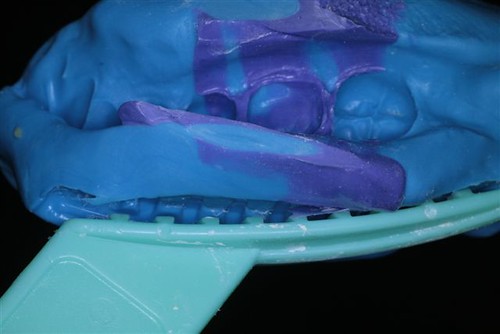
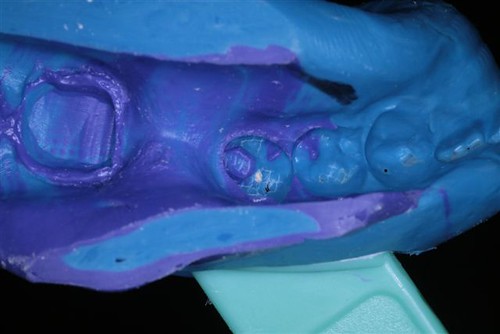
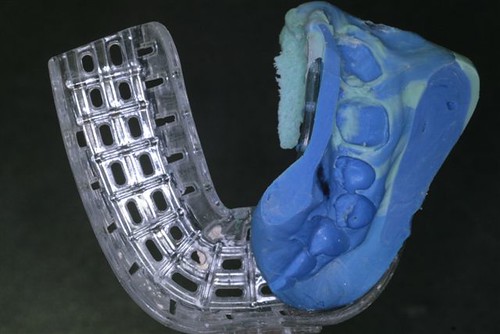
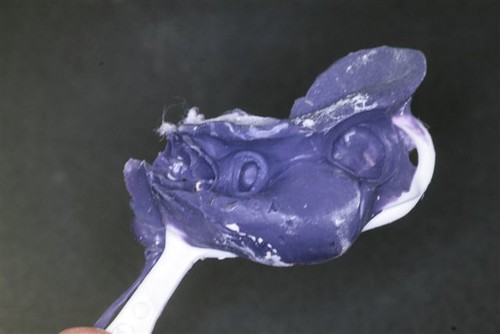
However, we prefer to pour 2 models of every case; one to work on and one as a check model - as can be seen from the image above, triple tray impressions often tear making a second pour impossible.


Triple trays have to be poured in plaster with both arches together, this way a lock can be made to locate the bite. However, if the patient bites through the tray and makes a hole the plaster runs through. The hole can be seen on the image above in the 5 region.


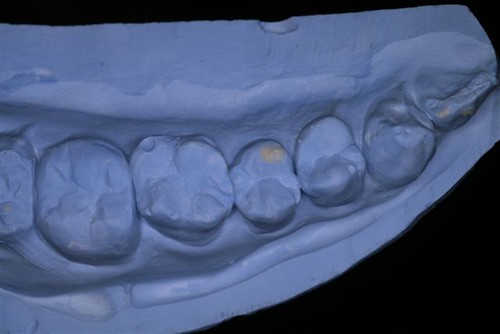
This image shows the resultant model, the yellow area on the 5 is where the opposing die stone has run through. This means that anywh
ere where there is a hole the models lock, this causes the model to break in this area and ultimately can lead to inaccuracies.

If you take this style of impression be please ensure that:
  1. There is an adequate thickness of impression material to prevent distortion
  2. The type of tray used has an imperveous membrane between the arches to prevent the models locking
  3. The impression material is stuck to the tray
Quadrant Impressions


The problem with quadrant impressions is achieving an accurate bite. even with a good squash record the models have a tendency to rock. If, as a dental team, we are looking for the highest quality we would like to recommend that we find an alternative to quadrant impressions.

Another problem with quadrant impressions is there is half the arch missing...
obviously! This means we can only equilabrate the restoration in working side occlusion, we are not able to do balancing side as the teeth which provide the guidance for this are missing. Once again this can lead to a compromise in quality.

The impression in this photo is also so small that we have very little to go on by way of reference. We can see so few teeth that even a working side occlusal balance will be difficult to achieve.


Lack of Impression Detail

The following information is taken from the 3M Espe trouble shooting guide "Taking better impressions", this excellent guide can be downloaded from our website.

Visual Appearance: Muted detail reproduction.
Result: Crowns may be too tight, or loose, and not fit correctly.

CAUSES & SOLUTIONS

For Polyether materials
Substances with pH <4

For all impressions
Impression material stored at elevated temperature.
Store impression material at room temperature.

Impression material stored at too low a temperature (prolongs the setting reactions, changes viscosity and requires exceptionally
high extrusion forces for automix materials).
Keep impression material at a temperature of
18°C/64°F at least one day prior use.

Thick blood/saliva pooled around prep.
Remove blood and saliva prior to making impression.

Use 2-step impression technique.

Inadequate retraction of sulcus around prep.
Use good retraction technique, with proper moisture control.

Exceeding the working time.
Follow manufacturer's working time specifications.
Choose material with longer working time.

Inadequate disinfection effects surface quality (detail reproduction) and
dimensional stability.
Use water based disinfectants according to FDA guidelines.

At SBO we're dedicated to getting the best from every aspect of dentistry... hense this blog... To get the most from your dentistry give us a call on 01707 663293

Regards,

Mark